Airbnb's 2026 Changes: What Vacation Rental Owners Need to Know (And What We're Doing About Them)
Airbnb's 2026 changes are reshaping vacation rental management, from new host fees to tighter rules on rental agreements, guest screening and checkout procedures. At The Boutique Home Group, we're adapting our strategies to protect owner revenue, stay compliant and keep properties performing at their best. Here's what owners need to know.
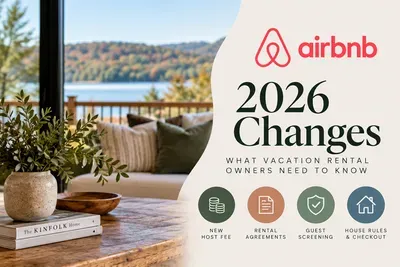
If you own a vacation rental, you've probably noticed quite a bit of discussion lately about Airbnb's latest changes. New service fees, restrictions on rental agreements, updated house rules and changes to what hosts can ask guests to do before checking out. There's a lot happening, and not all of the information circulating online tells the full story.
At The Boutique Home Group, we manage vacation rentals across multiple markets, including Galena, Illinois, Southwest Michigan and beyond. Keeping up with platform changes is a significant part of what we do, because even relatively small policy adjustments can have a meaningful impact on a property's profitability, guest experience and day-to-day operations.
We've been reviewing Airbnb's latest announcements and making adjustments to how we manage our properties. Here's what's actually changing, what it means for owners and how we're approaching it.
1. Airbnb's New 15.5% Host Fee: Are Owners Really Paying More?
One of the biggest changes this year is Airbnb's move toward a single service fee of 15.5%, replacing the traditional split-fee structure for affected hosts.
Previously, many hosts paid approximately 3% in service fees, while guests paid an additional service fee on top of the advertised nightly rate. Under the new structure, Airbnb generally deducts the entire 15.5% from the host's payout.
For hosts using property management or channel management software, the transition took effect on October 13, 2026.
Understandably, this has caused concern among property owners who suddenly see a much larger deduction from their bookings.
But here's the important distinction: a larger host-side fee doesn't necessarily mean an equivalent reduction in revenue.
Under the previous model, guests were already paying Airbnb's service fee. The new structure changes how that fee is collected and displayed.
Consider a simplified example:
Previously, a property advertised at $200 per night might cost the guest approximately $230 after Airbnb's guest service fee, while the host received around $194.
Under the new structure, advertising the property at approximately $230 would result in a host payout of around $194 after the 15.5% fee.
The guest pays roughly the same amount, and the owner receives roughly the same amount. The difference is how Airbnb accounts for the fee.
Of course, these examples exclude cleaning fees, taxes, discounts and other charges.
What we're doing differently
At The Boutique Home Group, we use dynamic pricing technology and actively manage rates across our properties. Rather than simply absorbing the additional host-side fee, our approach is to adjust Airbnb-specific pricing to protect owner revenue while remaining competitive in the market.
We're also reviewing how discounts, promotions, cleaning fees and channel-specific pricing interact with the new structure.
This matters because simply increasing every nightly rate by a flat percentage without understanding the underlying mathematics can leave money on the table or make a listing unnecessarily expensive.
Our objective isn't to achieve the highest advertised nightly rate. It's to maximize the revenue owners actually keep.
2. Airbnb Is Restricting Separate Rental Agreements
This is potentially one of the more significant operational changes for professional vacation rental managers.
Beginning November 20, 2026, Airbnb is introducing tighter restrictions on when hosts can require guests to sign a separate rental agreement.
Previously, hosts could generally require an additional agreement provided the requirement and its terms were properly disclosed.
Under the new policy, separate contracts will generally only be permitted in specific circumstances, including:
When required by law or community association rules.
When necessary for an optional amenity, such as a golf cart rental.
For stays of 28 nights or longer.
For qualifying Airbnb Luxe listings.
For bookings made before November 20, the previous policy continues to apply.
For professional operators, this raises legitimate questions about liability, property protection and the enforceability of additional rental terms.
Many management companies have historically relied on separate agreements to reinforce house rules, outline guest responsibilities and provide additional contractual protection.
What we're doing differently
We're reviewing our rental agreement procedures and identifying which properties may qualify for an exception under Airbnb's new policy.
Where separate agreements are no longer permitted, we'll focus on ensuring that important expectations are clearly communicated through Airbnb's approved listing settings, house rules and guest messaging.
We're also reviewing how our guest protection and screening procedures work alongside Airbnb's restrictions.
It's important to recognize that Airbnb's policy doesn't eliminate the need to protect an owner's investment. It changes which tools managers can use and how those protections must be implemented.
For owners, this is precisely the sort of behind-the-scenes adjustment that can be easy to overlook when self-managing a property.
3. Guest Screening Is Becoming More Complicated
Alongside the changes to rental agreements, Airbnb is tightening restrictions on collecting personal information from guests.
Under its updated policies, hosts generally cannot require guests to provide additional personal information, identification documents or background-check details outside Airbnb's permitted exceptions.
There are limited allowances for legal compliance and certain other circumstances, but the rules are becoming more restrictive.
This creates an interesting challenge for professional managers.
On one hand, Airbnb wants to make the booking process simpler and protect guest privacy. On the other, property owners understandably want confidence that their homes are being rented responsibly.
This is particularly important for larger vacation homes, properties with expensive amenities and homes located within communities with strict occupancy or conduct requirements.
What we're doing differently
We use professional guest protection and screening services as part of our broader risk-management approach.
We're reviewing those workflows to ensure that any information requests, verification procedures and guest communications comply with Airbnb's updated requirements.
Where screening methods are restricted, we'll rely on permitted platform tools, clear booking requirements, documented house rules and appropriate property protection coverage.
We don't believe protecting an owner's property should depend on a single screening method. It should involve several layers of risk management, each appropriate to the booking platform and property.
4. Airbnb's New House Rules and Checkout Requirements
Another change generating considerable attention is Airbnb's updated approach to house rules and checkout instructions, also taking effect for bookings made on or after November 20, 2026.
Airbnb is standardizing house rules and placing greater emphasis on what constitutes a reasonable request.
For example, hosts generally cannot require guests to complete substantial cleaning tasks that would ordinarily be handled by professional cleaners.
That includes requirements such as stripping beds, washing and putting away dishes, or completing laundry before departure.
Reasonable requests, such as placing used dishes in the sink, gathering towels or sorting rubbish and recycling, may still be permitted.
The distinction matters.
Guests should treat vacation rentals respectfully, but they shouldn't be expected to perform the work of a professional cleaning team, particularly when they've already paid a cleaning fee.
What we're doing differently
We're reviewing checkout instructions across our portfolio to ensure they align with Airbnb's updated expectations.
Our preference has always been to make departures straightforward for guests while ensuring our cleaning teams can prepare homes efficiently for the next arrival.
We're also reviewing how house rules are displayed, particularly for properties with hot tubs, swimming pools, community amenities and HOA restrictions.
Rules need to be clear, reasonable and communicated before booking, rather than introduced after a reservation has been confirmed.
The best guest experience is one where expectations are understood from the beginning, not discovered at checkout.
5. Airbnb Is Introducing More Pricing and Management Tools
Not every change is restrictive.
Airbnb's fall 2026 updates also include additional pricing tools, improved multi-listing management features and changes to how guests discover properties.
Airbnb is expanding its dynamic pricing capabilities, allowing participating hosts to automatically adjust nightly rates within recommended ranges based on supply and demand.
For owners managing one or two properties, these tools may offer a useful starting point.
However, automated pricing alone doesn't necessarily produce the strongest financial performance.
Why we still believe in hands-on revenue management
At The Boutique Home Group, we combine professional pricing software with regular human oversight.
We look at booking pace, seasonal demand, local events, occupancy gaps, competing listings and how far in advance guests are booking.
A weekend in Galena during a major local event requires a different pricing strategy from a quiet midweek period in January. Similarly, summer demand along Lake Michigan behaves very differently from winter demand.
Our approach also includes reviewing minimum-night requirements, adjusting last-minute pricing and identifying opportunities to fill otherwise vacant dates without unnecessarily discounting high-demand periods.
Airbnb's new tools are welcome, but we see them as another source of information rather than a replacement for a thoughtful revenue-management strategy.
6. What About Airbnb's Changing Search and Discovery Features?
Airbnb is also introducing more AI-powered features to help guests find suitable accommodations.
These developments reinforce something we've believed for a long time: successful vacation rental marketing involves much more than uploading attractive photographs and writing a short description.
Guests increasingly search for very specific experiences, amenities and property characteristics.
A family looking for a secluded home with a hot tub, multiple ensuite bedrooms and access to outdoor activities has different priorities from a couple looking for a walkable weekend getaway.
The more accurately a listing communicates those features, the easier it is for guests to determine whether it's the right fit.
What we're doing differently
We're continuing to refine our listing descriptions, amenity selections, photography and property information.
That includes making sure important features are accurately represented, property layouts are clear and descriptions answer the questions guests are most likely to ask.
We also believe that transparent descriptions reduce disappointment, improve reviews and attract guests who are genuinely suited to a property.
Search technology may change, but good hospitality still begins with setting the right expectations.
7. What Should Vacation Rental Owners Do Right Now?
If you're managing your own Airbnb, we'd recommend reviewing several areas before the November policy changes take effect.
Check your pricing. Make sure your rates account for Airbnb's new fee structure and that you're comparing the total guest price, not just the advertised nightly rate.
Review your rental agreements. Determine whether you can continue requiring a separate contract under Airbnb's new rules.
Audit your guest screening process. If you're using external forms or verification services, make sure your procedures comply with Airbnb's updated restrictions.
Update your house rules and checkout instructions. Remove unreasonable cleaning requirements and ensure important property rules are disclosed correctly.
Review your listing quality. Accurate amenities, professional photography, clear descriptions and competitive pricing remain essential.
And perhaps most importantly, don't assume that a policy change affecting one booking platform automatically applies to every other platform.
Airbnb, Vrbo and direct bookings can operate under different requirements. A professional management strategy needs to account for those differences rather than treating every reservation identically.
Our Perspective: Vacation Rental Management Is Becoming More Complex
There's a broader trend worth paying attention to.
Vacation rental management is becoming increasingly sophisticated.
What once involved creating a listing, coordinating cleaning and responding to guest messages now requires a much deeper understanding of pricing technology, platform policies, local regulations, guest protection, marketing and financial reporting.
For some owners, self-management remains a perfectly reasonable choice.
But for owners who want their property to perform as a serious investment, staying current with these changes requires time, expertise and consistent attention.
At The Boutique Home Group, we deliberately take a boutique approach to property management. We're not trying to manage thousands of properties through a standardized, one-size-fits-all system.
Instead, we focus on understanding the individual homes we manage, the markets they operate in and the owners who have entrusted us with their investments.
That means adapting when Airbnb changes its policies, questioning whether new technology genuinely benefits owners and continually looking for opportunities to improve performance.
We don't view these latest changes as a reason for panic. We see them as another reminder that successful vacation rental management requires being proactive rather than reactive.
Considering professional management for your vacation rental?
Whether you own a property in Galena, Southwest Michigan or another market we serve, we're always happy to discuss how we approach pricing, guest management, property protection and the day-to-day realities of running a successful vacation rental.
Learn more about The Boutique Home Group at www.boutiquehome.group.
This article reflects Airbnb's published policies and announcements as of October 27, 2026. Platform policies may change, and certain exceptions apply. Property owners should also consider applicable local laws, insurance requirements and community regulations.