Ganges Township Has Approved Its Short-Term Rental Ordinance
Ganges Township has officially adopted new short-term rental regulations, introducing a 175-license cap, annual registration, property inspections, and new occupancy and safety requirements. For existing vacation rental owners and those considering investing in the area, these changes could have significant implications. We break down what the ordinance means, what owners need to do next, and how The Boutique Home Group is helping operators navigate the new rules.
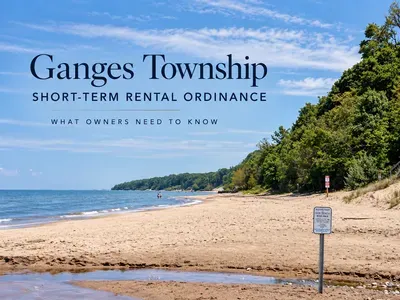
October 23, 2026 | The Boutique Home Group | Southwest Michigan Vacation Rental Management
After months of uncertainty, Ganges Township has officially approved its new short-term rental regulations. For owners of vacation rentals in Glenn, Fennville, and the surrounding area, the decision brings some much-needed clarity, but also a few important challenges.
Ordinance No. 70 was adopted on October 13, 2026, and takes effect November 20, 2026. It introduces annual registration, property inspections, occupancy restrictions, and a township-wide limit on the number of short-term rental licenses.
For anyone already operating a vacation rental, or considering purchasing one, these changes deserve close attention.
At The Boutique Home Group, we own and manage vacation rentals throughout Southwest Michigan, including properties in the Ganges Township area. We've been following the discussions closely, both as property owners ourselves and as a management company working with other owners.
Here's what you need to know.
The Biggest Change: A Limit of 175 Rental Licenses
Perhaps the most consequential part of the new ordinance is the decision to limit Ganges Township to 175 short-term rental licenses.
This is a significant development for a community where vacation rentals have long been part of the local tourism economy.
Applications will be reviewed in the order they are received. Importantly, an application is not considered accepted until the township has scheduled the property inspection and provided written acknowledgement that the application is complete.
If an application is missing information, it can be placed on hold while the township moves on to the next applicant.
Once 175 licenses have been issued, additional applications cannot be accepted or approved until a license becomes available.
What about existing vacation rentals?
This is understandably the question causing the most concern among current owners.
The adopted ordinance does not provide an explicit guarantee that properties already operating as vacation rentals will automatically receive a license.
For owners who purchased, renovated, and invested in properties with the understanding that short-term rentals were permitted, this creates an uncomfortable situation.
Our advice is simple: don't assume that because your property has operated successfully for several years, its future registration is guaranteed.
Existing operators should make preparing their applications a priority.
What Will Owners Need to Do?
The new ordinance introduces several requirements that owners should begin preparing for now.
Annual registration
Every short-term rental must be registered with the township each calendar year. An administrative fee will apply, with the amount established separately by the Township Board.
Property inspections
Owners must agree to township inspections. Properties with septic systems will also need appropriate septic inspection documentation and ongoing compliance.
Liability insurance
Owners will need to demonstrate that their property carries at least $1 million in liability insurance. It's worth speaking with your insurance provider to make sure your policy meets the ordinance's requirements rather than assuming your Airbnb or Vrbo coverage is sufficient.
Floor plans and parking information
Applications must include a floor plan identifying bedrooms, utility connections, and shutoff locations, along with information showing where vehicles can park.
The permitted number of parking spaces and maximum occupancy must also be reflected in rental agreements and advertising.
A local contact
Owners who live more than 45 miles from their rental must appoint a local designated agent. The owner or designated agent must be able to attend the property within one hour when contacted by the township or law enforcement about an issue.
This is an important consideration for second-home owners who live in Chicago, elsewhere in Michigan, or out of state.
New Occupancy Limits Could Affect Rental Income
The ordinance establishes a maximum overnight occupancy of 12 people per property, although some homes will have a lower limit.
The calculation is based on two guests per bedroom, plus two additional guests per qualifying finished level, up to the maximum of 12.
For example, a three-bedroom home with one qualifying finished level would generally be limited to eight overnight guests.
Finished basements and attics need particular attention. These spaces cannot automatically be counted toward occupancy without the required inspection process.
For owners of larger vacation homes, this could have a meaningful financial impact.
A property that previously accommodated 14 or 16 guests may need to reduce its advertised capacity, potentially affecting nightly rates, group bookings, and overall revenue.
We recommend reviewing your current occupancy settings across Airbnb, Vrbo, direct booking websites, and your rental agreement before the ordinance takes effect.
Minimum Stays and Property Types
The ordinance prohibits rentals of less than two days, meaning operators should review any one-night booking options currently available.
It also limits eligible short-term rentals to qualifying single-family dwellings.
Attached condominiums, duplexes, and apartment units with adjoining walls are specifically excluded, along with recreational vehicles, yurts, tents, and other nontraditional accommodations.
Anyone considering purchasing an investment property in Ganges Township should verify its eligibility before making financial commitments.
A property being advertised as a successful vacation rental does not necessarily mean it will qualify under the new rules.
Safety, Septic Systems, and Guest Information
Beyond licensing, the ordinance introduces operational requirements that owners and managers will need to incorporate into their routines.
These include working smoke detectors in bedrooms, carbon monoxide detectors on each floor, appropriate inspections, and clearly displayed property information.
Owners must also provide guests with a map identifying property boundaries.
This may sound like a small detail, but in rural and wooded areas, where property lines are not always obvious, it's particularly relevant.
Septic systems are another important consideration. Owners should locate their inspection and pumping records now, especially if they have not had the system serviced recently.
Many of these requirements reflect good vacation rental management practices already. The difference is that they will now form part of a formal township compliance process.
What Happens if an Owner Doesn't Comply?
The ordinance gives the township enforcement powers, including financial penalties and the potential suspension or revocation of rental registrations.
Operating without the required registration can result in substantial fines, including recurring daily penalties.
For owners who rely on rental income to cover mortgage payments, property taxes, and operating expenses, losing the ability to rent could have serious consequences.
This is why we believe compliance needs to be treated as an ongoing part of running a vacation rental business, rather than simply a form to complete once a year.
What Should Existing Owners Do Right Now?
If you already operate a short-term rental in Ganges Township, we'd recommend taking the following steps:
Contact the township about registration. Confirm when applications will be accepted, what documentation is required, and how the application queue will work.
Gather your property records. Locate your floor plan, septic documentation, insurance policy, parking information, and existing rental agreement.
Review your occupancy. Make sure the number of guests advertised is consistent with the new calculation and that any finished basement or attic meets the necessary requirements.
Check your safety equipment. Verify that smoke and carbon monoxide detectors are correctly installed and functioning.
Confirm your local management arrangements. If you live outside the area, make sure you have someone who can respond promptly when needed.
Review your future bookings. Identify any reservations that may be affected by changes to occupancy or minimum-stay requirements, and seek guidance before making changes to confirmed bookings.
Keep records of everything. Save correspondence with the township, inspection reports, registration confirmations, and other compliance documentation.
Perhaps most importantly, don't leave the application process until the last minute.
With a limited number of licenses available, preparation could make a real difference.
Thinking About Buying a Vacation Rental in Ganges Township?
Ganges Township remains an attractive location for vacation rentals.
The area's proximity to Lake Michigan, charming rural communities, wineries, beaches, and popular destinations such as Saugatuck and South Haven continues to make it appealing to visitors.
However, the new ordinance changes how potential investments should be evaluated.
Previously, buyers could focus primarily on location, purchase price, rental demand, and projected revenue.
Now, licensing availability needs to be one of the first questions.
Before purchasing, buyers should confirm that the property is eligible for registration, understand its permitted occupancy, and establish whether a license is available.
We would be particularly cautious about relying on a seller's historical rental income without first considering how the new regulations might affect future operations.
The ordinance also creates uncertainty around properties changing ownership, so buyers should not assume an existing registration can simply be transferred with a sale.
Our Perspective: A Challenging Change, but Not the End of Vacation Rentals
We understand why communities want to regulate short-term rentals.
Responsible management, guest safety, appropriate parking, and respect for neighbors are all important. We believe professional vacation rental operators have a responsibility to maintain those standards.
At the same time, we're concerned about the implications of limiting licenses in an area where owners have already made significant investments in good faith.
Many vacation rental properties support local cleaners, maintenance contractors, landscapers, restaurants, and other small businesses. Their contribution to the local economy shouldn't be overlooked.
The absence of clear protections for existing operators is particularly concerning.
We hope the township will provide a transparent, practical registration process and clear communication to owners as the new rules are implemented.
For now, our focus is on helping property owners understand the requirements, prepare appropriately, and continue operating responsibly.
How The Boutique Home Group Can Help
Managing a successful vacation rental has always involved more than creating an Airbnb listing and welcoming guests.
With additional local regulations, having reliable systems and knowledgeable people on the ground becomes even more important.
The Boutique Home Group provides boutique vacation rental management throughout Southwest Michigan, including Glenn, Fennville, Saugatuck, Douglas, and South Haven.
We help owners with guest communication, local coordination, property oversight, pricing, listing management, and the day-to-day details that keep a vacation rental running smoothly.
We're also following the Ganges Township licensing changes closely as we prepare our own operations and support the owners we work with.
If you own a vacation rental in Ganges Township and are unsure what the new ordinance means for your property, we'd be happy to talk.
Whether you're looking for full-service management or simply exploring your options, we're always pleased to connect with fellow property owners.
Learn more about The Boutique Home Group at www.boutiquehome.group.
Source: Ganges Township Short-Term Rental Ordinance No. 70, adopted October 13, 2026, effective November 20, 2026.
This article is intended as general information for property owners and vacation rental operators. It is not legal advice. Owners should consult Ganges Township directly and seek professional advice where appropriate.